

IngeniousGuruIngeniousGuru
SEO

Why isn't my business website ranking on Google?

January 15, 2025

Your business website may not rank because Google cannot properly find the page, the page does not match what people are searching for, or other results appear more useful and trustworthy. Ranking is not controlled by one switch, so the fastest path is to identify the weak layer first.

Start with evidence, not guesses. Google's Search Console Performance report shows which queries and pages receive impressions and clicks. If a page has no impressions at all, check whether it is indexed before rewriting it.
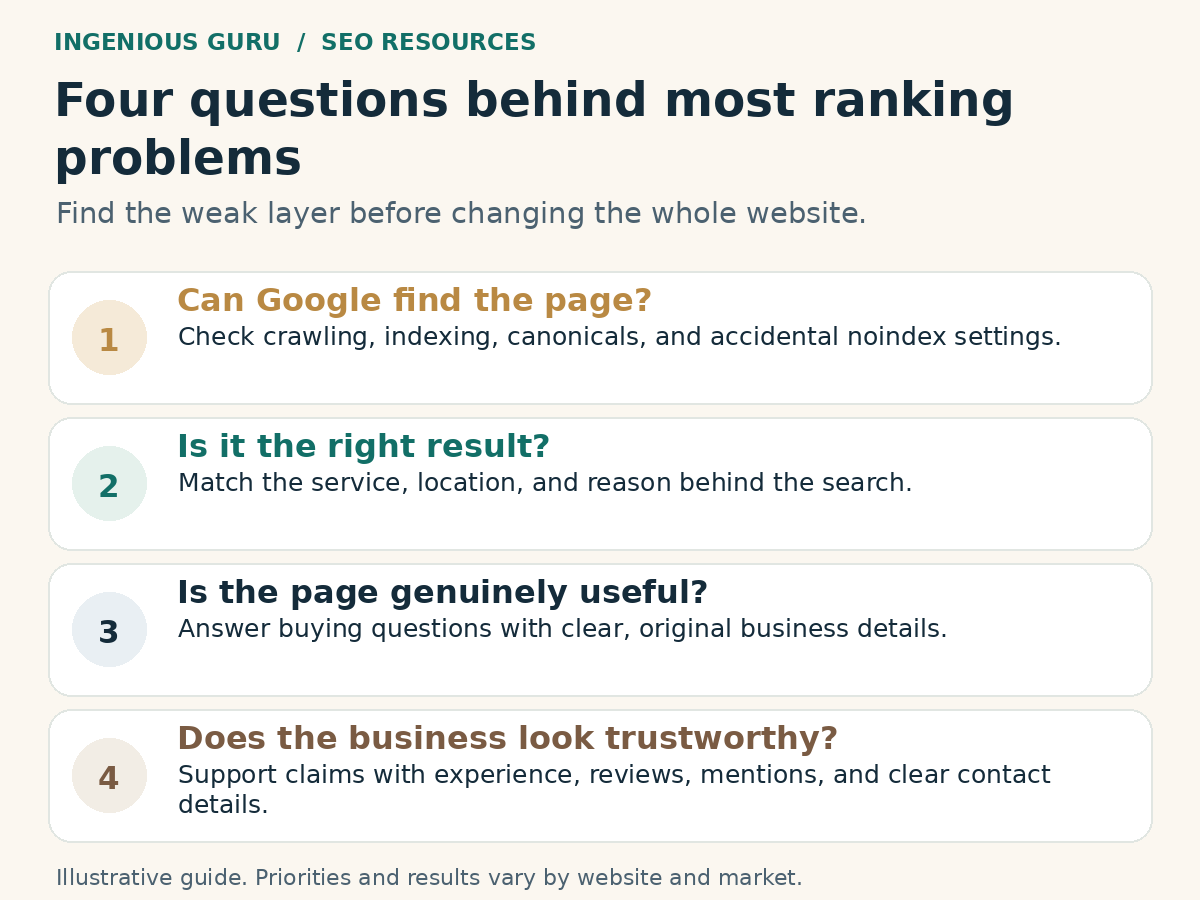
Four-step checklist covering website discovery, search intent, usefulness, and business trust.
Ranking problems usually come from one or more layers—not one secret setting.

First, check whether Google can access and index the page

Use the URL Inspection tool for your homepage and main service pages. Look for an accidental noindex tag, a robots.txt block, a wrong canonical URL, a redirect problem, or a page that returns an error. A new site may also need time and links from other pages before Google discovers it.

Make sure the page matches the search

A page titled "Services" is usually too broad to rank for a specific need. If you offer commercial roof repair in Phoenix, create a useful page about that exact service and location. Explain who it is for, what problems you solve, how the process works, and how someone can request help.

Conceptual illustration of a business owner using a magnifying glass to inspect website crawl, content, and trust issues.
A useful ranking diagnosis separates technical access, relevance, content quality, and trust signals. Conceptual illustration.

Give visitors information they cannot get from a generic article

Add original details from your business: real service options, pricing factors, common customer questions, service-area limits, relevant photos, and your experience. Google's people-first content guidance recommends original, substantial information created to benefit readers—not pages written mainly to manipulate rankings.

Strengthen trust and discovery

Link important pages from your navigation and related articles. Keep your business name, address, phone number, and policies clear. Earn relevant mentions from local organizations, suppliers, industry directories, and publications. Avoid buying large batches of links; they can create risk without helping customers.

What should you do first?

  • Choose one important service page.
  • Check its indexing status and Search Console impressions.
  • Compare it with the results currently shown for the target search.
  • Fix the clearest gap, then measure the page over the next few weeks.

A practical first step: Inspect one URL today. If it is indexed but gets impressions without clicks, improve its title and search-result message. If it gets no impressions, review relevance, content, and internal links.

If the cause is still unclear, Ingenious Guru's SEO team can review the technical, content, and competitive layers and turn the findings into a prioritized plan—without promising an overnight ranking.

Related SEO Resources

View All
SEO

How do I get my business on the first page of Google?

Focus on the searches your customers use, create helpful pages that match those searches, and make sure Google can find your website.

Read Resource
SEO

How long does SEO take to rank a new website?

A new website may be discovered and indexed within days or weeks, but meaningful SEO growth commonly takes several months.

Read Resource
SEO

How much does SEO cost for a small business?

Small-business SEO can cost from a few hundred dollars for a limited one-time task to several thousand dollars per month for ongoing strategy and execution.

Read Resource
SEO

Is SEO worth paying for in 2026?

SEO can be worth paying for in 2026 if potential customers search for what you sell, a new customer has meaningful value, and you can invest for several months.

Read Resource
SEO

Why did my Google rankings suddenly drop?

Google rankings can drop because search demand changed, a technical problem blocked pages, the website was redesigned or migrated, content became less useful, competitors improved, or Google's systems changed.

Read Resource
SEO

How do I rank for local keywords?

To rank for local keywords, connect one real service with one real location and create the best page for that need.

Read Resource
SEO

How can I get more organic traffic to my website?

To get more organic traffic, improve pages that already match valuable searches and create new pages only where a real customer need is missing.

Read Resource
SEO

How do I compete with bigger companies on Google?

A small business can compete with bigger companies on Google by choosing narrower searches, showing deeper firsthand expertise, building strong local trust, and making it easier for the right customer to act.

Read Resource
SEO

Can you audit my website and tell me why it's not ranking?

A useful SEO audit can explain the most likely reasons a website is not ranking and what to fix first. But an accurate diagnosis requires the website URL and, ideally, read-only access to Google Search Console and analytics.

Read Resource