

IngeniousGuruIngeniousGuru
SEO

How long does SEO take to rank a new website?

January 15, 2025

A new website may be discovered and indexed within days or weeks, but meaningful SEO growth commonly takes several months. For planning, many small businesses use a three-to-six-month window for early traction, while competitive searches can take longer. That is an estimate—not a promise from Google.

Google says some changes can appear within hours, while others can take several months, and it generally recommends waiting a few weeks before judging the effect of SEO work. Its SEO Starter Guide is the best baseline for expectations.
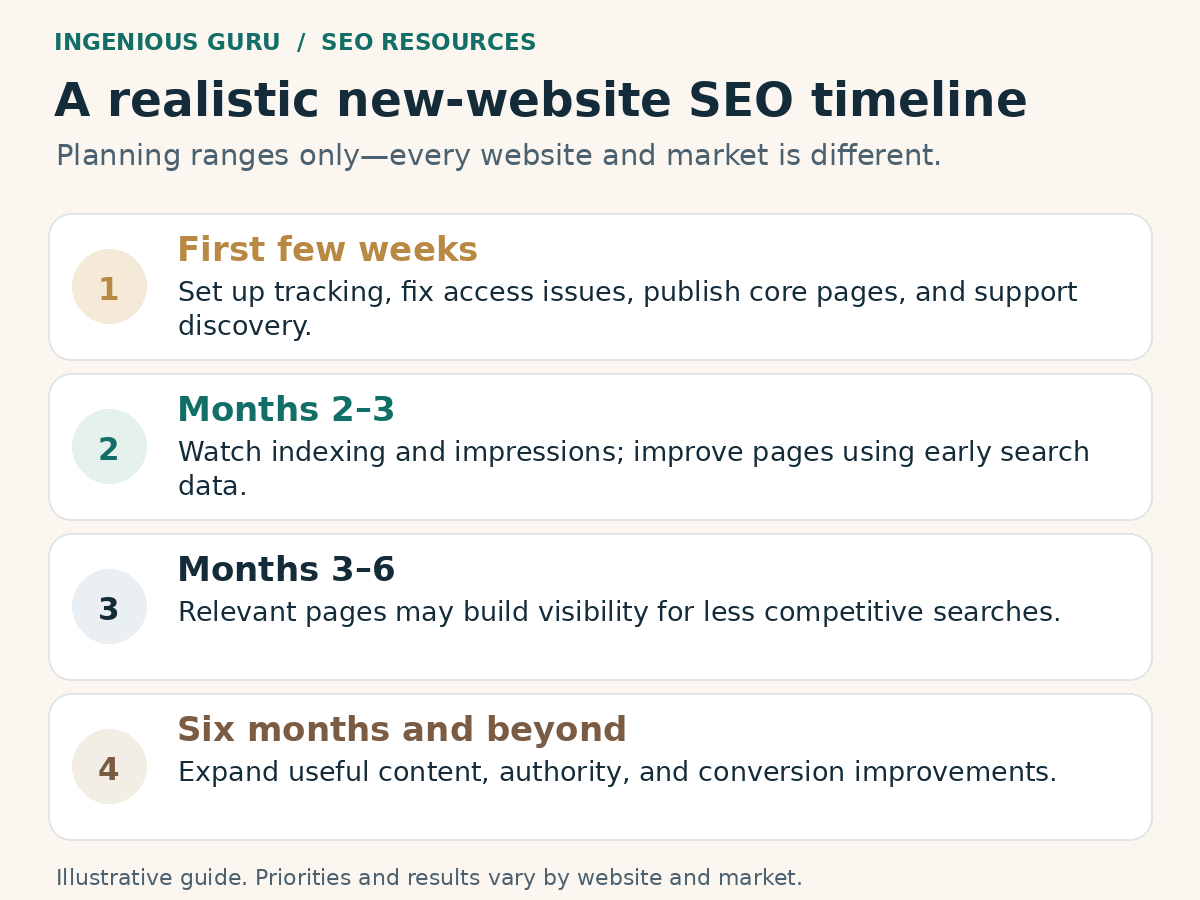
Illustrative SEO timeline from the first few weeks through six months and beyond.
Use the timeline to plan work and measurement, not as a ranking guarantee.

Indexing and ranking are different milestones

Indexing means Google has stored a page and may show it. Ranking means the page is selected for a particular search and position. Google notes that crawling can take from a few days to a few weeks, but requesting a crawl does not guarantee inclusion or a high position. Check important URLs with URL Inspection in Search Console.

Your starting point changes the timeline

A focused local service site with clear pages may show progress sooner than a new national store competing with established brands. The timeline also depends on technical health, content quality, market competition, existing reputation, useful links, and how consistently improvements are made.

Conceptual illustration of a business owner planning SEO with a calendar, budget, growing plant, and website.
SEO progress usually builds in stages as a website is discovered, improved, and trusted. Conceptual illustration.

Look for progress before page-one rankings

Early progress may appear as more pages indexed, more impressions, a wider set of relevant queries, better click-through rates, and the first organic leads. These signals show whether the site is moving in the right direction even before a major keyword reaches page one.

You can improve the process, but you cannot force it

Publish strong service pages at launch, use descriptive internal links, submit a sitemap, keep the site fast and usable, and build genuine awareness in your market. Avoid mass-produced pages and paid link schemes. Shortcuts can waste time or create a larger problem later.

A sensible 90-day focus

  • Month 1: tracking, indexing, technical checks, and core service pages.
  • Month 2: improve pages using real query and competitor-result observations.
  • Month 3: add supporting content, strengthen internal links, and review leads.

A practical first step: Record today's indexed pages, impressions, clicks, and organic enquiries. Review the same numbers every month so you judge progress from your own baseline.

If you want a realistic timeline based on your market and website condition, Ingenious Guru's SEO services can audit the starting point and build a staged plan with measurable milestones.

Related SEO Resources

View All
SEO

How do I get my business on the first page of Google?

Focus on the searches your customers use, create helpful pages that match those searches, and make sure Google can find your website.

Read Resource
SEO

Why isn't my business website ranking on Google?

Your business website may not rank because Google cannot properly find the page, the page does not match what people are searching for, or other results appear more useful and trustworthy.

Read Resource
SEO

How much does SEO cost for a small business?

Small-business SEO can cost from a few hundred dollars for a limited one-time task to several thousand dollars per month for ongoing strategy and execution.

Read Resource
SEO

Is SEO worth paying for in 2026?

SEO can be worth paying for in 2026 if potential customers search for what you sell, a new customer has meaningful value, and you can invest for several months.

Read Resource
SEO

Why did my Google rankings suddenly drop?

Google rankings can drop because search demand changed, a technical problem blocked pages, the website was redesigned or migrated, content became less useful, competitors improved, or Google's systems changed.

Read Resource
SEO

How do I rank for local keywords?

To rank for local keywords, connect one real service with one real location and create the best page for that need.

Read Resource
SEO

How can I get more organic traffic to my website?

To get more organic traffic, improve pages that already match valuable searches and create new pages only where a real customer need is missing.

Read Resource
SEO

How do I compete with bigger companies on Google?

A small business can compete with bigger companies on Google by choosing narrower searches, showing deeper firsthand expertise, building strong local trust, and making it easier for the right customer to act.

Read Resource
SEO

Can you audit my website and tell me why it's not ranking?

A useful SEO audit can explain the most likely reasons a website is not ranking and what to fix first. But an accurate diagnosis requires the website URL and, ideally, read-only access to Google Search Console and analytics.

Read Resource