

Small-business SEO can cost from a few hundred dollars for a limited one-time task to several thousand dollars per month for ongoing strategy and execution. The right amount depends on the market, website condition, number of services or locations, and how much work your team can handle internally.
As a broad agency-market reference, Clutch's 2026 SEO pricing guide says most listed agencies charge about $100–$149 per hour, reviewed SEO projects are often below $10,000, and monthly agency fees commonly run from $2,000 to $20,000. Those figures cover many business sizes, so they are context—not a required small-business budget.
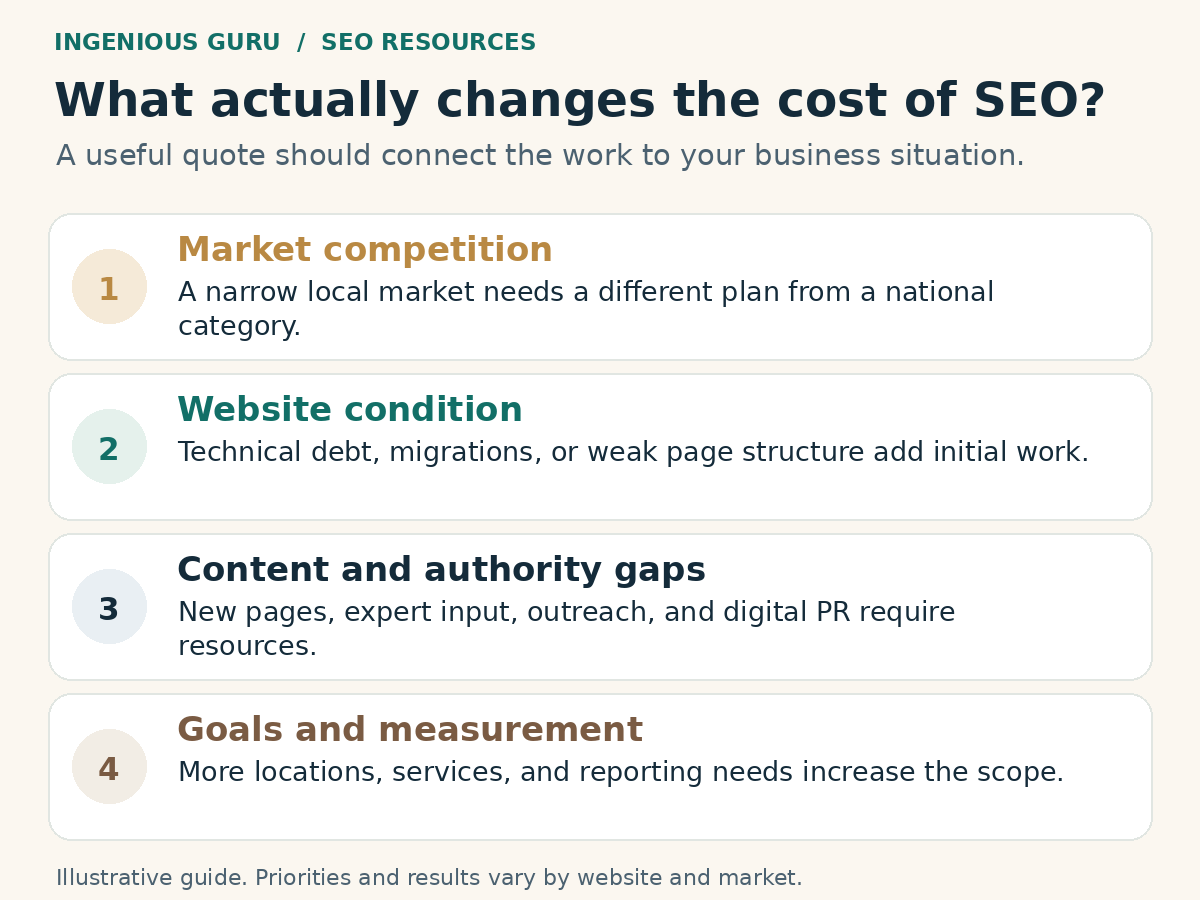
Choose the pricing model that matches the problem
A one-time audit works when you have someone who can implement the recommendations. A project fee suits a defined task such as a site migration or service-page rebuild. A monthly retainer fits ongoing content, technical improvements, local SEO, authority building, and measurement. Hourly consulting can support an in-house team.
Ask what the fee actually includes
Two proposals with the same price can deliver very different work. Request a plain-language scope showing which pages will be improved, what technical work is included, who creates content, how links or mentions are earned, how often progress is reviewed, and which business results will be measured.

Set the budget against customer value
Estimate the gross profit from a new customer and how many additional customers would justify the monthly investment. For example, if SEO costs $1,200 per month and an average new customer contributes $600 in gross profit, you need two additional customers to cover that monthly cost. Use conservative numbers and allow for the time SEO takes.
Be careful with unusually cheap full-service offers
Low cost is not automatically bad, but the promised scope must be believable. Avoid guaranteed rankings, secret methods, mass link packages, and vague reports. Google's guide to hiring an SEO warns that irresponsible work can damage a site's visibility and reputation.
A sensible way to compare proposals
- Give every provider the same business goals and website information.
- Compare priorities, deliverables, ownership, reporting, and cancellation terms.
- Ask what will happen in the first 30, 60, and 90 days.
- Choose the clearest credible plan—not simply the lowest price.
A practical first step: Write down your top service, target area, monthly lead value, and available internal time. Those four details make an SEO quote much easier to evaluate.
For a transparent example, Ingenious Guru publishes its SEO package ranges and offers a free audit before recommending a plan. Use the audit to understand the work needed before choosing a budget.