

IngeniousGuruIngeniousGuru
SEO

How do I compete with bigger companies on Google?

January 15, 2025

A small business can compete with bigger companies on Google by choosing narrower searches, showing deeper firsthand expertise, building strong local trust, and making it easier for the right customer to act. You do not need to outrank a national brand for every broad keyword to win profitable organic leads.

Google says its systems aim to prioritize helpful and reliable information. The Search Essentials recommend using the words people search for in prominent places, making links crawlable, and creating people-first content. Company size is not a substitute for a useful result.
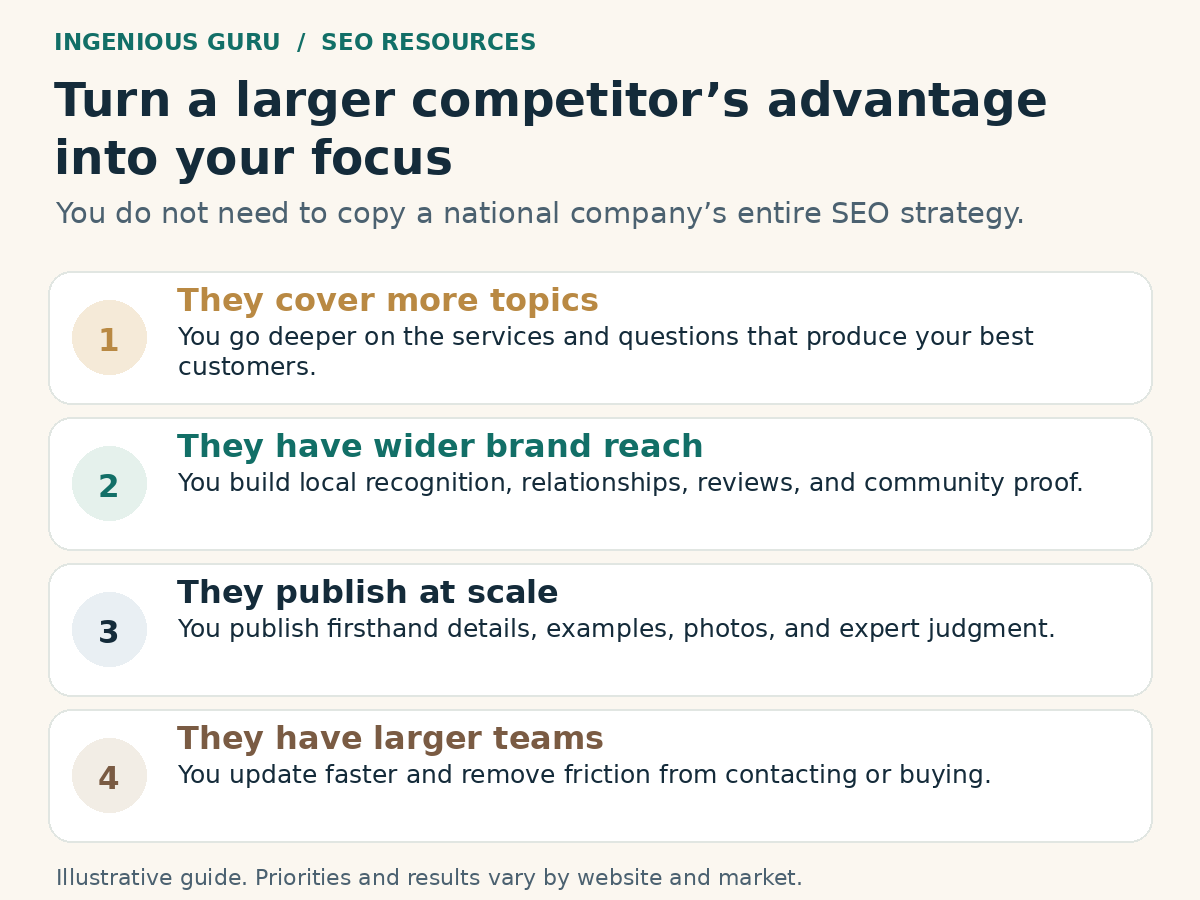
Four focused ways a smaller business can counter advantages held by larger companies.
Specific relevance and real experience can create opportunities that broad competitors overlook.

Choose a winnable search lane

Broad terms such as "insurance" or "marketing" may be dominated by large brands. Focus on a valuable combination of service, customer type, problem, and place. "Bookkeeping for dental practices in Tampa" gives a specialist more room to prove relevance than "bookkeeping services."

Create the most useful page for that exact need

Explain your process, typical timelines, pricing factors, common mistakes, limitations, and what makes a customer a good fit. Include real examples, original photos, author experience, and clear contact details. A smaller site can often add specificity that a large template-driven site misses.

Conceptual illustration of a discoverable local storefront and website with larger office towers in the distance.
A smaller business can compete by being the clearest and most relevant choice for a focused customer need. Conceptual illustration.

Build depth before chasing volume

Create one excellent main service page and a small group of supporting resources that answer the questions around it. Link them together clearly. Update them as customer needs change. Ten strong, connected pages can be more valuable than 100 shallow pages produced only to target keywords.

Use your local and relationship advantages

Maintain your Business Profile, earn honest reviews, join relevant local organizations, contribute expert information to industry publications, and build real partnerships. These activities can produce trust, referrals, mentions, and links that a remote national brand cannot easily copy.

Measure the battles that matter

  • Track leads and sales by service page, not only broad rankings.
  • Look for high-impression queries where your page is already close.
  • Improve conversion speed, clarity, and follow-up on mobile.
  • Expand only after a focused topic or location begins working.

A practical first step: List the three customer problems your business solves better than a large competitor. Choose one and build the clearest service page and supporting guide in your market.

If you need help finding that winnable lane, Ingenious Guru can analyze competitor and keyword gaps and turn them into a focused SEO roadmap that fits a smaller business.

Related SEO Resources

View All
SEO

How do I get my business on the first page of Google?

Focus on the searches your customers use, create helpful pages that match those searches, and make sure Google can find your website.

Read Resource
SEO

Why isn't my business website ranking on Google?

Your business website may not rank because Google cannot properly find the page, the page does not match what people are searching for, or other results appear more useful and trustworthy.

Read Resource
SEO

How long does SEO take to rank a new website?

A new website may be discovered and indexed within days or weeks, but meaningful SEO growth commonly takes several months.

Read Resource
SEO

How much does SEO cost for a small business?

Small-business SEO can cost from a few hundred dollars for a limited one-time task to several thousand dollars per month for ongoing strategy and execution.

Read Resource
SEO

Is SEO worth paying for in 2026?

SEO can be worth paying for in 2026 if potential customers search for what you sell, a new customer has meaningful value, and you can invest for several months.

Read Resource
SEO

Why did my Google rankings suddenly drop?

Google rankings can drop because search demand changed, a technical problem blocked pages, the website was redesigned or migrated, content became less useful, competitors improved, or Google's systems changed.

Read Resource
SEO

How do I rank for local keywords?

To rank for local keywords, connect one real service with one real location and create the best page for that need.

Read Resource
SEO

How can I get more organic traffic to my website?

To get more organic traffic, improve pages that already match valuable searches and create new pages only where a real customer need is missing.

Read Resource
SEO

Can you audit my website and tell me why it's not ranking?

A useful SEO audit can explain the most likely reasons a website is not ranking and what to fix first. But an accurate diagnosis requires the website URL and, ideally, read-only access to Google Search Console and analytics.

Read Resource