

GEO stands for Generative Engine Optimization. It is the practice of improving how a brand and its information are discovered, understood, selected, mentioned, or cited in AI-generated answers. GEO builds on SEO; it does not replace the need for crawlable pages, useful content, and authority.
The term was formalized in the Generative Engine Optimization research published at KDD 2024, which described a framework for improving source visibility in generative-engine responses. Results from one benchmark should not be treated as a universal business guarantee.
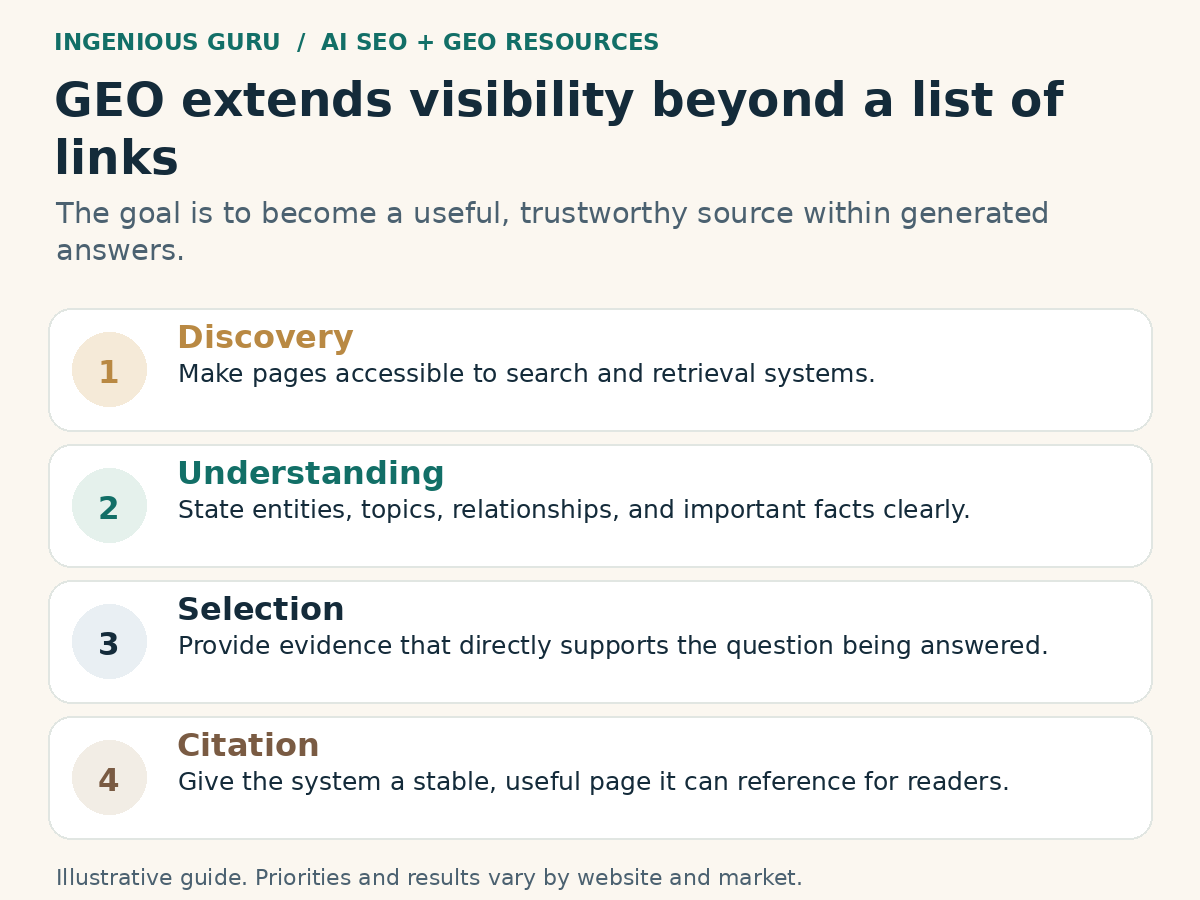
How GEO differs from a traditional ranking goal
Traditional SEO often measures page positions and organic clicks. GEO also looks at whether an answer mentions the brand, cites its page, represents its facts accurately, or uses its information to support a comparison. The visible outcome may change with the prompt.
What GEO work includes
Typical work covers crawler access, entity and business clarity, topic strategy, source-worthy content, structured data that matches visible facts, digital PR, review quality, citation analysis, prompt testing, and referral or conversion measurement.

What GEO does not mean
It does not mean stuffing questions into every heading, publishing hundreds of near-duplicate AI articles, creating fake third-party mentions, or adding unsupported "AI schema." No consultant can guarantee that a closed system will use a specific source.
How GEO and SEO should work together
Good SEO helps useful pages become discoverable and trusted. GEO adds attention to answer selection, citations, entity consistency, and visibility across conversational queries. Google itself says in its AI optimization guidance that GEO and AEO work remains part of the broader search experience.
How a small business can start
Pick a profitable topic, identify the questions and comparisons around it, and improve one authoritative page with original expertise and clear evidence. Then build legitimate outside recognition and track whether AI referrals or mentions lead to qualified actions.
- Keep technical SEO and indexing healthy.
- Clarify the company, services, audience, and locations.
- Publish evidence that adds something new to the answer.
- Track mentions, citations, referrals, leads, and accuracy.
Related guide: What is AI SEO?
A practical first step: Choose one customer question and review whether your best page is accessible, specific, well supported, current, and clear about who produced the information.
If you want GEO applied to real business goals, Ingenious Guru can build an AI-search visibility plan around priority topics, credible sources, technical access, and measurable outcomes.