

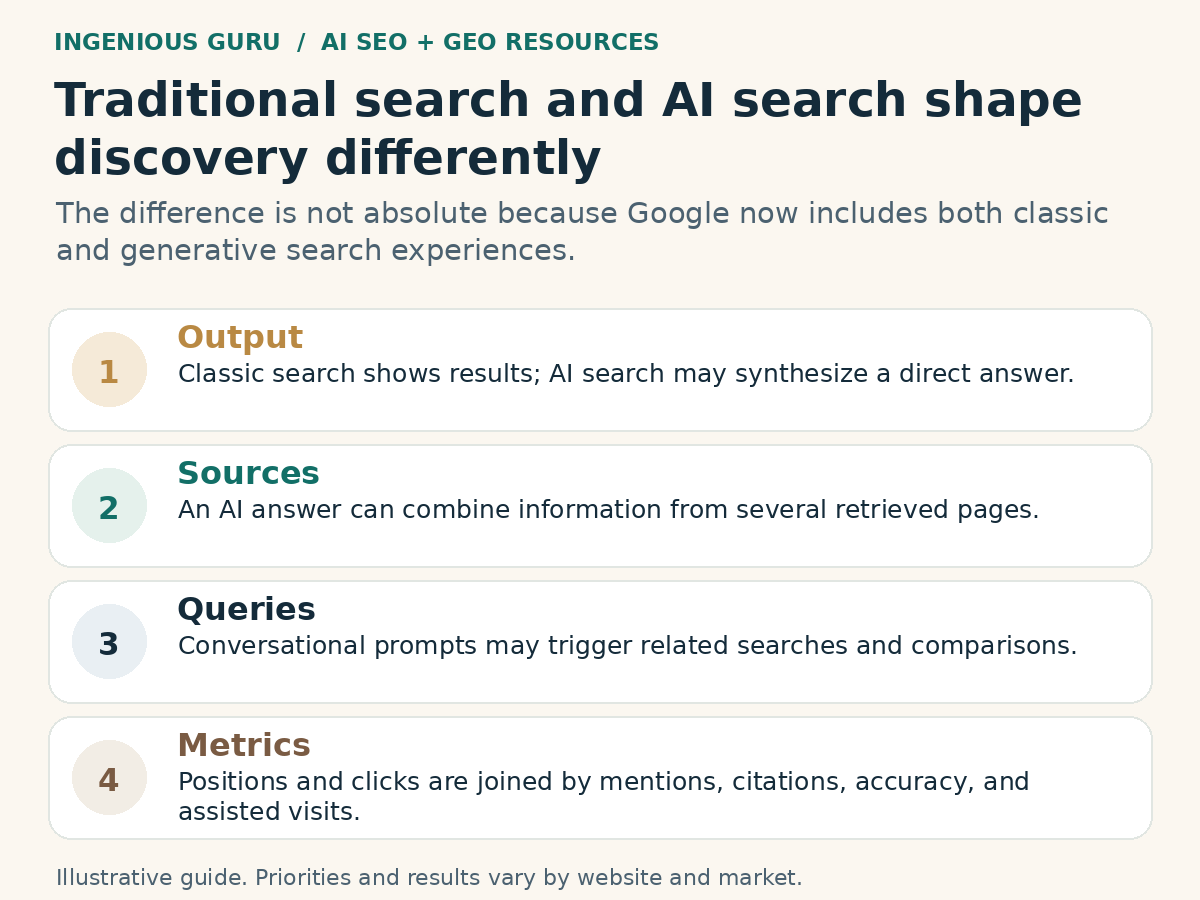
Traditional Google search commonly shows a ranked set of links and search features. AI search may retrieve several sources and combine them into a conversational answer with supporting links. The boundary is no longer simple because Google Search itself includes AI Overviews and AI Mode.
Google explains that AI Overviews and AI Mode can use related-query fan-out to gather supporting information. OpenAI separately uses OAI-SearchBot for ChatGPT search discovery. Each product controls its own systems and results.
The user journey may begin with an answer
In classic search, a person often chooses a link before reading the full information. In AI search, the system may provide a summary first and the user visits a cited source for detail, verification, comparison, or action.
AI search can expand one prompt into related needs
A detailed question may lead the system to retrieve definitions, product details, local information, comparisons, risks, and next steps. A website therefore benefits from clear topic coverage and strong connections between related pages.

Authority is evaluated across more than the company website
Business pages provide official facts, while independent reviews, publications, profiles, and primary sources may provide confirmation. This does not make owned content unimportant; it means important claims should be specific and verifiable.
The same page can support both experiences
A crawlable, useful, well-structured page can rank in traditional results and serve as a supporting source in an AI answer. There is no need to create a lower-quality duplicate written only for machines.
Reporting needs a wider set of measures
Continue tracking rankings, impressions, clicks, and conversions. Add AI citations, mentions, referral traffic, landing pages, accuracy, and assisted conversions. Compare the business value of visits rather than assuming lower click volume means lower impact.
- Keep standard SEO because AI systems still rely on web discovery.
- Create complete answers for conversational and comparison needs.
- Make important facts easy to verify across sources.
- Add AI visibility and accuracy to existing reporting.
Related guide: Does SEO help you rank in ChatGPT?
A practical first step: Take one profitable topic and map the classic keyword, the detailed conversational question, the likely follow-up questions, and the best page for each distinct need.
If you want one plan for both journeys, Ingenious Guru can align SEO and GEO priorities so the same high-quality pages support traditional rankings, AI citations, and conversions.