
If you’ve spent any time building backlinks, you’ve probably heard this advice: “Don’t waste your time on nofollow links. They don’t help SEO.” For years, that was the accepted wisdom in the SEO world.
But here’s the twist: do nofollow links help SEO more than most marketers think? The honest answer is a little more complicated than a simple yes or no.
Google has quietly changed how it treats these links since 2019. And in 2026, the old “nofollow is worthless” advice is starting to look outdated. In this guide, we’ll break down exactly what nofollow links are, what Google actually says about them, and how you can use them to support your SEO strategy instead of ignoring them.
By the end, you’ll know whether nofollow links deserve a spot in your link-building plan and how to use them the right way.
Whether you’re a small business owner trying to grow organic traffic, a blogger chasing your first thousand visitors, or an experienced marketer trying to sharpen your strategy, SEO guide will give you a clear, no-fluff answer.
What Is a Nofollow Link? A Quick Refresher
Let’s start with the basics.
A nofollow link is a hyperlink with a small piece of code attached to it: rel=”nofollow”. This tag tells search engines not to pass ranking credit (often called “link juice”) to the page it points to.
By contrast, a normal link sometimes called a “dofollow” link passes that credit automatically. There’s no special code needed. Every link is treated as a dofollow link unless you tell search engines otherwise.
Here’s a simple example of what the code looks like:
html
<a href=“https://example.com” rel=“nofollow”>Example Site</a>
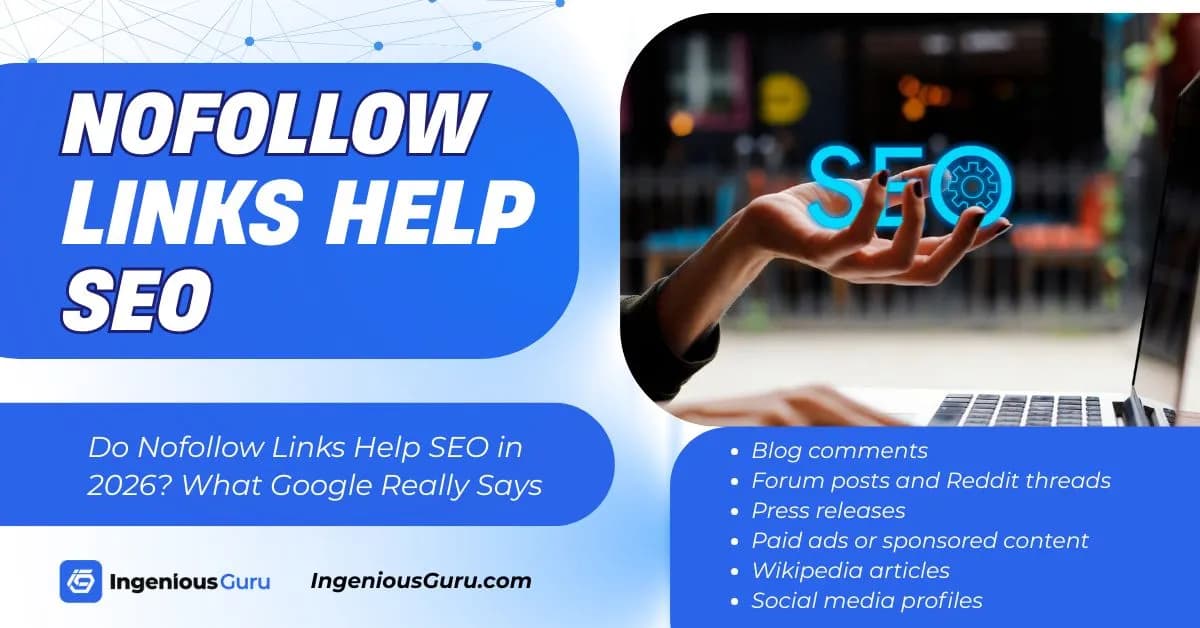
You’ll usually find nofollow links in places like:
- Blog comments
- Forum posts and Reddit threads
- Press releases
- Paid ads or sponsored content
- Wikipedia articles
- Social media profiles
Site owners use nofollow tags to avoid vouching for content they don’t control, or to follow Google’s rules around paid links.
Think of it like a verbal disclaimer. If you mention a product in conversation but add “I’m not personally recommending this, just so you know,” you’re doing the human version of a nofollow tag. You’re sharing information without putting your full reputation behind it.
That’s really all a nofollow link is: a small disclaimer written in code instead of words.
How Nofollow Looks From a Browser’s Point of View
Here’s something worth clearing up early: from a regular visitor’s perspective, a nofollow link looks and behaves exactly like any other link. It’s still blue, still clickable, and still takes you to the same destination. The nofollow tag is invisible to humans. It only changes how search engine crawlers interpret and treat the link behind the scenes.
This is important to remember, because it means nofollow links are never “broken” or less functional for your actual readers. The only difference lives in the code, not the user experience.
Why Google Introduced the Nofollow Tag in the First Place
Nofollow links weren’t always around. Google introduced the tag back in 2005 to fight a big problem: comment spam.
Back then, spammers were flooding blog comment sections with links, hoping to boost their own rankings. Nofollow gave website owners a way to add links without accidentally passing SEO value to spammers.
For over a decade, the rule was simple. Nofollow meant “don’t count this link at all.” Google wouldn’t follow it, and it wouldn’t pass any ranking value.
This simple rule shaped an entire generation of SEO strategy. Marketers built elaborate systems to track which sites offered dofollow versus nofollow links. Entire tools and browser extensions popped up just to help people spot the difference at a glance. Backlink checkers separated the two into different columns, and link-building agencies often priced their services differently depending on which type of link they were selling.
For a long time, this black-and-white thinking made sense. Nofollow meant zero value. Dofollow meant full value. There wasn’t much room for nuance.
Then, in 2019, everything changed.
The 2019 Update That Changed the Nofollow Game
In 2019, Google announced a major shift in how it handles link attributes. This is the update that really matters if you’re asking whether nofollow links help SEO in 2026.
Here’s what changed:
Google introduced two new link attributes: rel=”sponsored” and rel=”ugc”. These gave website owners more specific ways to label their links.
- rel=”sponsored” for paid links, ads, and sponsorships
- rel=”ugc” for user-generated content, like comments and forum posts
- rel=”nofollow” the general-purpose tag, still used when none of the above quite fit
Why did Google bother splitting one tag into three? Because a single catch-all attribute was hiding too much useful information. A comment link and a paid advertisement were both getting the same nofollow label, even though they represent completely different situations. By separating them out, Google gained a clearer picture of what’s really happening across the web’s massive link graph.
But the bigger change wasn’t the new tags. It was how Google decided to treat all three attributes going forward.
From Strict Rule to Flexible Hint
Before 2019, nofollow was a hard rule. If a link had the tag, Google ignored it completely, no exceptions.
After the update, Google started treating nofollow (and the two new attributes) as hints rather than strict commands. According to Google’s own developer documentation, links marked with these attributes will generally not be followed, but the pages they point to may still be discovered and crawled through other means, such as sitemaps or other incoming links.
In plain English: Google reserves the right to still look at these links if it finds them useful for understanding your site, your niche, or spam patterns. It just won’t treat them as a strong ranking signal.
This is a subtle but important distinction. It’s the reason so many SEO experts today say nofollow links “probably” don’t directly boost rankings but almost all agree they still matter for other reasons.
Why “Hint” Doesn’t Mean “Ignore”
A lot of confusion comes from the word “hint” itself. Some marketers hear “hint” and assume it means the tag basically does nothing now. That’s not quite right either.
A more accurate way to think about it: Google is keeping its options open. In the vast majority of everyday cases, a nofollow link will still behave the way it always did, no ranking credit passed, no direct SEO boost. But Google reserves the flexibility to look at these links in aggregate, especially when trying to detect spam patterns, unnatural link schemes, or paid link networks trying to sneak around the rules.
In other words, the hint system gives Google more data to work with, without making any promises about how that data gets used. For everyday website owners, this distinction rarely changes day-to-day strategy. What it does change is the mindset: nofollow links are not automatically invisible or meaningless to Google’s systems, even if they don’t directly move your rankings.
So, Do Nofollow Links Help SEO Directly?
Let’s tackle the big question head-on.
For direct ranking purposes, most evidence still points to no. Nofollow links generally don’t pass the kind of link equity that pushes your pages up in search results. Google’s own guidance confirms that pages linked to with rel=”nofollow” typically won’t get direct credit toward rankings.
However and this is the part that gets missed “doesn’t directly boost rankings” is not the same thing as “does nothing for your SEO.”
Here’s why that distinction matters so much.
The Indirect SEO Benefits of Nofollow Links
Even without passing traditional link equity, nofollow links can still support your SEO strategy in several real, measurable ways.
1. They Drive Referral Traffic
A nofollow link is still a clickable link. If someone clicks it, they land on your site. More visitors can mean:
- More time-on-site signals
- More potential email sign-ups
- More brand awareness
- More chances for those visitors to link to you later (this time, without a nofollow tag)
A single nofollow mention on a high-traffic site like Reddit or a major news outlet can send thousands of visitors your way, even if it does nothing for your rankings directly.
Consider a hypothetical example. Imagine a small kitchenware brand gets mentioned in a roundup article on a major lifestyle site, with a nofollow link attached. That single mention could realistically drive hundreds of new visitors within the first week alone. Some of those visitors will bounce right away. But others might sign up for an email list, follow the brand on social media, or make a purchase. None of that depends on whether the link passed ranking credit.
This is why smart marketers stopped asking “is this link dofollow?” as their first question when evaluating an opportunity. Instead, they ask: “Will this link put me in front of the right audience?” That single shift in thinking opens up a lot more valuable opportunities.
2. They Build Brand Authority and Recognition
Search engines increasingly look at brand signals: how often your brand is mentioned across the web, in what contexts, and by which sources. A nofollow mention from a respected publication still tells Google (and your future customers) that your brand exists and shows up in relevant conversations.
This is sometimes called an “implied link” or brand mention, and many SEO professionals believe Google factors this into its broader understanding of a site’s authority, even without a clickable followed link attached.
There’s also a compounding effect at play here. The more places your brand name shows up across the web, whether linked, nofollow linked, or simply mentioned in text, the stronger the overall picture Google builds of your brand as a real, recognized entity in your industry. This concept, sometimes discussed under the umbrella of “entity SEO,” suggests that consistent visibility across many sources adds up over time, even when individual mentions don’t pass traditional link equity.
3. They Create a Natural, Balanced Link Profile
Here’s something a lot of marketers overlook: a backlink profile made up of 100% dofollow links doesn’t look natural. Real websites, blogs, and brands naturally pick up a healthy mix of nofollow and dofollow links over time through comments, social shares, forum mentions, and press coverage.
If your link profile is suspiciously “clean,” with nothing but perfectly optimized dofollow links, it can raise red flags with Google’s spam systems. A natural sprinkle of nofollow links helps your backlink profile look organic, not manufactured.
Think about how real, popular websites naturally earn links. A trending news article, a viral product, or a well-known local business will almost always pick up a mix of link types: some dofollow, some nofollow, some from comments, some from forums, some from social platforms. That messy, varied mix is exactly what a natural link profile looks like. When your own backlink profile mirrors that pattern, it signals authenticity rather than manipulation.
4. They Help With Content Discovery
Even though nofollow links don’t reliably pass ranking credit, Google has confirmed that pages linked to with these attributes may still get crawled through other pathways. In some cases, a nofollow link can still be one of the ways Google’s crawlers first discover a new page on your site.
This matters most for brand-new websites or freshly published pages that don’t yet have much of a footprint. If your page hasn’t been picked up by sitemaps or other indexed sources yet, a nofollow link shared on a busy forum or community site could still be the very first path Google’s crawler follows to find it. Getting discovered faster, even through an indirect route, can help newer content start appearing in search results sooner.
5. They Diversify Your Traffic Sources
Relying entirely on organic search traffic is risky. Algorithm updates happen, rankings shift, and competition increases every year. Nofollow links from platforms like Reddit, Quora, industry forums, and niche communities create additional traffic channels that don’t depend on your Google rankings at all.
This kind of traffic diversification builds a more resilient overall marketing strategy. Even during a slow month for organic search, steady referral traffic from nofollow sources can help keep your numbers stable.
Nofollow vs. Sponsored vs. UGC: What’s the Difference?
Since 2019, Google recommends using more specific tags where they apply, instead of defaulting to nofollow for everything. Here’s a simple breakdown:
| Link Type | When to Use It | Example |
| Dofollow (default) | Standard editorial links you want to vouch for | Linking to a helpful resource in your blog post |
| Nofollow | General-purpose tag for links you don’t want to endorse or pass credit to | Linking to a competitor for comparison purposes |
| Sponsored | Paid links, ads, affiliate links, sponsorships | A paid product placement in a blog post |
| UGC | User-generated content you don’t control | Blog comments, forum replies |
You can even combine attributes. For example, rel=”nofollow ugc” is a valid way to flag a user-generated link while staying compatible with other search engines that may not fully support the newer tags.
Quick Tip
You don’t need to go back and update every old nofollow link on your site. Google has said the classic nofollow tag is still perfectly acceptable. Focus on using the right tag going forward, especially for new sponsored or user-generated content.
Common Mistakes Marketers Make With Nofollow Links
Now that you understand what nofollow links actually do, let’s cover a few mistakes that trip people up.
- Using nofollow to try to stop a page from being indexed. That’s not what it’s for. If you want to prevent indexing, use a noindex tag instead.
- Building a backlink profile that’s almost entirely nofollow or UGC links. Without a healthy number of editorial dofollow links, your profile can look weak for competitive keywords.
- Forgetting to tag paid or sponsored content. Google’s spam policies treat undisclosed paid links that pass ranking credit as a form of link spam, which can put your site at risk of a manual penalty.
- Assuming all nofollow links are worthless, so you skip valuable opportunities. A nofollow mention from a major publication can still be worth pursuing for traffic and brand exposure alone.
- Nofollowing your own social media profile links. Google recommends using rel=”me” for links to your own profiles instead, so search engines understand these represent you.
- Chasing nofollow links from low-quality, spammy sites. A nofollow tag doesn’t make a bad link “safe.” Links from spammy directories or link farms can still hurt your site’s reputation and user trust, regardless of the attribute attached.
- Ignoring anchor text and context entirely because “it’s just nofollow anyway.” Even without passing link equity, the surrounding text and context of a mention can still shape how people (and potentially Google’s broader systems) perceive your brand.
How to Measure the Real Value of Nofollow Links
Since nofollow links won’t show up as ranking boosts in most SEO tools, you’ll need to look at other metrics to understand their true impact. Here’s what to track instead:
- Referral traffic in Google Analytics. Check which nofollow sources are sending you visitors, and how those visitors behave once they land on your site.
- Branded search volume. If a nofollow mention leads to more people searching your brand name directly, that’s a strong sign it’s working.
- Social shares and engagement. A nofollow link shared widely on social media often triggers a ripple effect of additional shares and mentions.
- Conversion tracking. Set up goals or events to see whether traffic from nofollow sources converts into leads, sign-ups, or sales.
- Direct traffic bumps. Sometimes people see a mention, don’t click right away, but type your website into their browser later. This can show up as a small bump in direct traffic around the same time as a big nofollow mention.
Tracking these numbers gives you a much clearer picture than simply asking whether a link is dofollow or nofollow.
Should You Actively Pursue Nofollow Links in 2026?
Short answer: yes, as part of a balanced strategy just don’t make them your only focus.
Here’s a practical way to think about it. Treat nofollow link opportunities as a bonus, not your main course. Your core link-building efforts should still prioritize high-quality, editorial dofollow backlinks from relevant, authoritative sites in your niche.
That said, don’t turn down nofollow opportunities when they come with real upside, such as:
- A guest post or mention on a high-traffic site, even if the link is tagged nofollow
- A feature in a major news publication
- An active, engaged community like Reddit or Quora, where a well-placed answer can drive steady referral traffic for years
- Directory listings on well-known, reputable platforms
- Podcast show notes or interview mentions, even when the host’s site nofollows outbound links by default
- Local news coverage or community event sponsorships that come with a website mention
These links may not move your rankings directly, but they build the kind of visibility and traffic that supports your SEO efforts in the long run.
A Simple Framework for Deciding
When you’re weighing whether a nofollow opportunity is worth your time, ask yourself these three questions:
- Does this platform have real, engaged traffic in my niche? A nofollow mention on a quiet, low-traffic forum isn’t worth chasing. A mention on an active, high-traffic community can be very valuable.
- Will this link put my brand in front of people who are likely to become customers or readers? Relevance matters more than the link attribute.
- Does this opportunity cost me very little time or money to pursue? Many nofollow opportunities, like answering questions on Quora or contributing to niche forums, cost nothing but a bit of your time. Low effort, potential upside that’s usually worth it.
If the answer to most of these is yes, go for it. If not, your time is probably better spent elsewhere.
A Simple Nofollow Link-Building Checklist
Use this checklist to guide your approach going forward:
- Prioritize earning dofollow links from relevant, high-authority sites first
- Don’t turn down high-traffic nofollow opportunities, especially from popular platforms
- Tag paid placements and sponsorships with rel=”sponsored,” not nofollow
- Tag user-generated links with rel=”ugc” where possible
- Keep your overall link profile balanced and natural-looking
- Focus on brand mentions and visibility, not just link equity
- Avoid using nofollow as a substitute for noindex
Final Thoughts: Do Nofollow Links Help SEO?
So, do nofollow links help SEO in 2026? Not in the traditional sense of passing direct ranking credit. But writing them off completely would be a mistake.
Nofollow links can still drive real traffic, boost brand recognition, and help your backlink profile look natural and trustworthy in Google’s eyes. The smartest approach isn’t choosing between dofollow and nofollow links it’s building a strategy that welcomes both, while keeping your energy focused on earning genuine, high-quality editorial links wherever you can.
Nofollow links may not be the star of your SEO strategy, but they’ve earned a supporting role worth paying attention to.
Frequently Asked Questions
Do nofollow links help SEO rankings directly?
Not usually. Nofollow links generally don’t pass the ranking credit that helps a page climb in search results. However, they can still support your SEO efforts indirectly through traffic and brand visibility.
What’s the difference between nofollow and dofollow links?
A dofollow link is the default type of link and passes ranking credit to the linked page. A nofollow link includes a special tag telling search engines not to pass that credit.
Should I remove nofollow tags from my old links?
No. Google has confirmed that the classic nofollow tag is still an acceptable way to flag links, even after the 2019 introduction of the sponsored and UGC attributes.
Are nofollow links bad for SEO?
No, nofollow links aren’t harmful. Having some nofollow links is actually normal and helps your backlink profile look natural rather than artificially built.
Does Google still crawl nofollow links?
Sometimes. Google treats nofollow as a hint rather than a strict rule, meaning pages linked with a nofollow tag may still get crawled through other pathways, like sitemaps or other links.
Should I use nofollow for affiliate links?
It’s better to use rel=”sponsored” for affiliate and paid links, since Google introduced this tag specifically for that purpose in 2019.
Can too many nofollow links hurt my website?
No. Having nofollow links in your backlink profile is completely normal and expected. What can hurt your site is a pattern of low-quality, spammy links, regardless of which attribute they carry.
How can I check if a link is nofollow or dofollow?
You can view a page’s source code and search for rel=”nofollow” near the link, or use a free browser extension or SEO tool designed to highlight nofollow links automatically.
Found this helpful?
Share it with your network.