
Three years ago, “ranking #1” meant a blue link at the top of Google. Today, for a growing slice of searches, there’s no link at all just an AI-written answer, with your competitor’s name in it instead of yours.
That’s the shift behind the term everyone’s suddenly throwing around: AI search optimization, also called GEO (generative engine optimization) or AEO (answer engine optimization). Depending on who you ask, it’s either “the future of marketing” or “SEO with a new coat of paint.” The honest answer is somewhere in between, and we’ll get into exactly where.
We work on this daily at Ingenious Guru auditing sites for AI visibility, fixing the technical stuff that keeps content invisible to AI crawlers, and rebuilding content so it actually gets pulled into answers instead of ignored. This guide is the version of that work we wish existed when we started: grounded in what Google, Microsoft, and the platforms themselves have actually published, not recycled LinkedIn hot takes.
What AI Search Optimization Actually Means
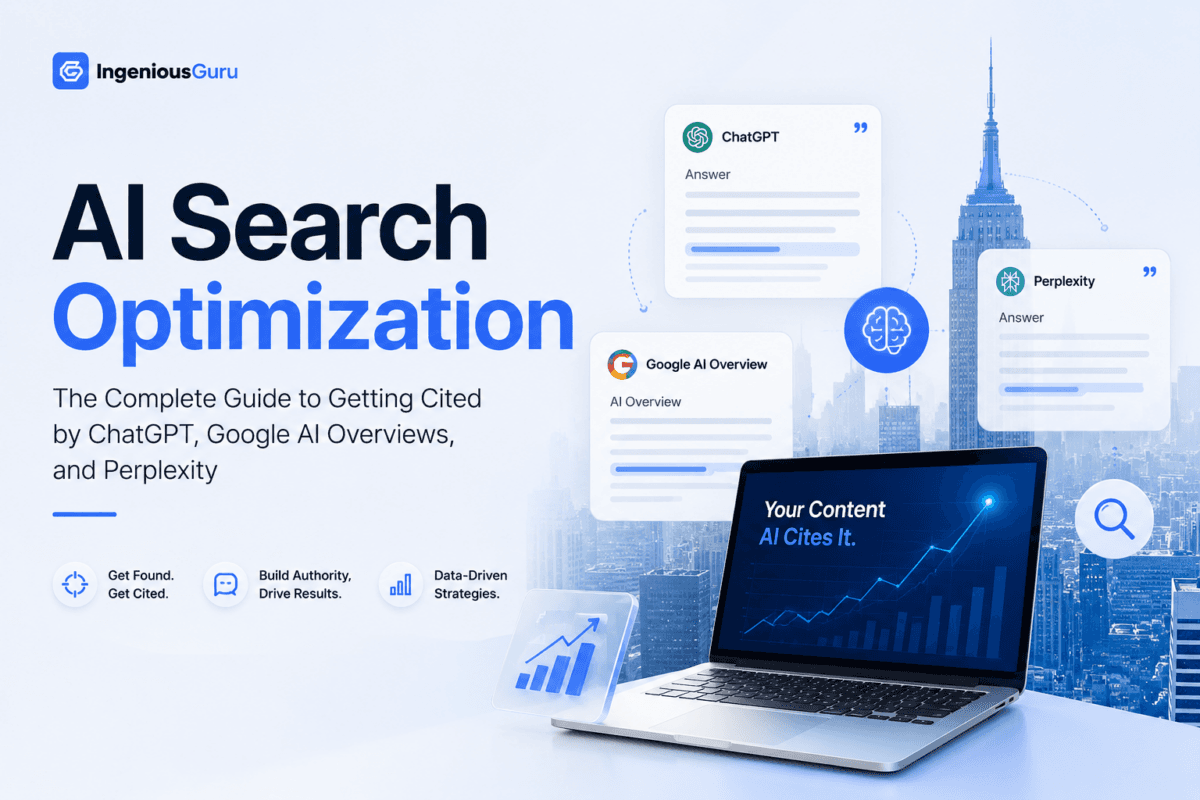
AI search optimization is the practice of structuring, writing, and technically preparing your content so that AI systems Google’s AI Overviews and AI Mode, ChatGPT, Perplexity, Gemini, Copilot, Claude can find it, understand it, trust it, and quote it in the answers they generate.
The distinction worth understanding: traditional SEO gets you a ranking position. AI search optimization gets you a citation a sentence, a stat, a paragraph of yours embedded inside someone else’s answer. Semrush’s research team found something that surprised even them: pages ChatGPT cited were ranking in position 21 or worse in traditional search almost 90% of the time. Rank position and citation-worthiness aren’t the same game.
Google, for what it’s worth, doesn’t think you need a separate discipline at all. Their official Search Central guidance is blunt about it: “optimizing for generative AI search is optimizing for the search experience, and thus still SEO.” Their AI Overviews and AI Mode run on the same ranking systems as regular Search Retrieval-Augmented Generation (RAG) pulls from the existing index, and a technique called query fan-out breaks your question into several related searches behind the scenes before assembling an answer.
Where it does get genuinely different is on platforms that don’t share Google’s index. ChatGPT leans heavily on its training data and, when web search is on, Bing’s index via its own crawler. Perplexity runs its own search index entirely. Claude, when web search is enabled, pulls from Brave Search. That means a page optimized purely for Google AI Overviews can be completely invisible to ChatGPT, and vice versa you’re not optimizing for one algorithm anymore, you’re optimizing for five.
Why This Matters More Than the Hype Suggests
Skip the vague “AI is changing everything” framing here’s what’s measurable:
- AI referral traffic to top websites jumped 357% year-over-year by June 2025, hitting 1.13 billion visits, according to TechCrunch and SimilarWeb data cited by Microsoft.
- Google’s AI Overviews were showing up on roughly 16% of searches as of November 2025, after peaking near 25% in July, per Semrush’s own tracking.
- Visitors who arrive via ChatGPT and other non-Google AI search convert 4.4x better than typical organic visitors — because by the time someone clicks through from an AI answer, they’ve already been “pre-sold” on the idea.
- Nearly a third of B2B buyers (29%, per G2’s 2025 Buyer Behavior Report) now say they reach for AI tools before Google.
Put together, this means two things for a business owner: fewer total clicks per search (because the AI answer satisfies a lot of queries on its own), but the clicks you do get are warmer, more qualified, and increasingly happen even when you’re not sitting in position #1 on Google. That second part is the opportunity. Right now, AI platforms are still citation-hungry there’s far less competition fighting for those spots than there is for page-one Google rankings. Smaller and newer sites genuinely have a shot here that they don’t have in traditional SERPs yet.
That window is closing, though. Every agency, SaaS company, and consultant is now racing to “do GEO,” which means the sites that establish themselves as trusted, frequently-cited sources this year will have a real head start over the ones who show up in 2027.
How AI Systems Actually Pick What to Cite
Before touching a single piece of content, it helps to understand the mechanics because most of the bad advice floating around (“add an llms.txt file!” “chunk everything into 300-word blocks!”) comes from people who skipped this part.
Parsing. AI assistants don’t read your page top to bottom the way a human does. Per Microsoft’s own engineering team, they break a page into smaller structured pieces headings, paragraphs, list items, table rows — evaluate each piece for relevance and authority, then stitch the best pieces from multiple sources into one answer. Your H2 and H3 structure isn’t cosmetic anymore; it’s literally how the machine decides where one idea ends and the next begins.
Retrieval-augmented generation (RAG). For grounded, up-to-date answers, the model doesn’t rely purely on what it memorized during training it retrieves live pages from a search index first, then generates a response based on what it finds. This is why being indexed and technically accessible is step zero, not a nice-to-have.
Query fan-out. A single question like “how do I fix a lawn full of weeds” silently expands into several related searches “best herbicides for lawns,” “remove weeds without chemicals,” “prevent weeds in lawn” and the AI pulls from whichever pages answer those sub-questions best. If your one article on the topic only answers the headline question and ignores the three obvious follow-ups, you’re leaving citations on the table.
The Practical Playbook
Here’s what actually moves the needle, roughly in order of impact.
1. Confirm AI crawlers can even reach your site
This sounds too basic to matter, and it’s the single most common thing we find broken in audits. Open yoursite.com/robots.txt and check you’re not blocking:
| Crawler | Belongs to |
| GPTBot, OAI-SearchBot, ChatGPT-User | OpenAI / ChatGPT |
| ClaudeBot, Claude-User, Claude-SearchBot | Anthropic / Claude |
| CCBot | Common Crawl (used to train many models) |
| Googlebot | Google Search & AI Overviews |
If any of these have Disallow: / next to them, you’ve silently opted your entire site out of AI visibility no amount of great content fixes that. Also check for login walls, JavaScript-only navigation crawlers can’t follow, and pages that are painfully slow to load. Walker Sands’ team specifically flags that many AI crawlers still can’t fully process client-side-rendered JavaScript, so if your site is built on React or Angular without server-side rendering, that’s worth a technical audit on its own.
2. Write content nobody else could have written
This is Google’s actual, stated position, and it’s the one piece of advice every source we reviewed agreed on: AI systems are drowning in generic content and actively de-prioritize it. Google draws a specific line between “commodity content” (a “7 Tips for First-Time Homebuyers” post that could’ve been written by anyone, including an AI) and “non-commodity content” the kind built on a real, specific experience, like “Why We Waived the Inspection & Saved Money: A Look Inside the Sewer Line.”
Practically, that means leading with first-hand data, a named case study, an opinion you’re willing to defend, or a number nobody else has published not a summary of five other articles on the same topic.
3. Structure every section to stand alone
Since AI systems lift individual sections rather than whole pages, each heading needs to work as its own self-contained unit:
- Phrase headings as the actual question someone would ask (“How much does AI search optimization cost?” beats “Pricing”)
- Answer the question in the first sentence under that heading, then expand with detail
- Use lists and tables for anything comparative or sequential they get lifted almost verbatim into AI answers
- Keep paragraphs short enough that a single paragraph can be pulled out of context and still make complete sense
4. Make claims specific, sourced, and quotable
“AI Overviews are becoming more common” is forgettable. “Google’s AI Overviews appeared on roughly 16% of searches as of November 2025” is the kind of sentence a model will actually lift and attribute. Every vague adjective in your content “leading,” “innovative,” “cutting-edge” is a missed opportunity to instead write “we cut load time from 4.2s to 1.8s and organic traffic rose 43% in two months.” Numbers, dates, and named sources are what separate quotable content from filler.
5. Add schema markup it’s still worth doing
Google’s own guidance says structured data isn’t required for AI features, but it remains part of a solid overall SEO strategy and helps you qualify for rich results elsewhere. Prioritize:
- Article schema — author, publish date, topic
- FAQPage schema — maps your Q&A sections directly for extraction
- HowTo schema — for step-based content
- Product/Review schema — if you sell anything, this feeds AI shopping answers directly
6. Build authority outside your own website
AI systems weigh what the rest of the internet says about you, not just what you say about yourself. That means earning genuine mentions and backlinks from industry publications, keeping your Wikipedia entry (if you have one) and Google Business Profile accurate, and having team members answer questions authentically on Reddit and Quora rather than dropping promotional links. This off-site layer is the part most businesses skip entirely and it’s usually the difference between a well-written page that never gets cited and one that does.
7. Keep it updated
AI systems, ChatGPT especially, visibly favor recency a mediocre article published yesterday will frequently outrank a genuinely excellent one from 2022. If a page matters to your business, revisit it every few months: refresh the stats, mention the current year, note what’s changed.
What You Can Safely Ignore
Because this space is new, it’s also full of confident-sounding nonsense. Google’s own documentation goes out of its way to debunk a few specific myths, and we’d add one of our own from what we see in client audits:
- You don’t need an llms.txt file. Google explicitly states it ignores these. They may matter to some third-party AI tools, but they won’t move your Google visibility at all.
- “Chunking” your content into artificially short pieces isn’t necessary. Google’s systems already understand multi-topic pages and extract the relevant piece. Write for the length your topic actually needs.
- You don’t need a separate page for every possible search variation. This crosses into what Google calls scaled content abuse, and it can actively hurt you rather than help.
- Buying “mentions” from low-quality sites doesn’t work the way people think. AI systems weigh authority, not volume a hundred spammy citations carry less weight than one from a publication the model already trusts.
How to Measure Whether Any of This Is Working
Most businesses skip measurement entirely and just hope. Don’t. Three approaches, from free to paid:
- Google Search Console’s Generative AI performance report shows how your pages are actually performing inside AI Overviews and AI Mode specifically.
- Manual testing ask ChatGPT, Perplexity, Gemini, and Claude the exact questions your customers would ask. Note who gets cited and how they phrase things. Do this monthly at minimum.
- Dedicated AI visibility tools platforms like Semrush’s AI Optimization suite, Profound, and Otterly.AI track brand mentions and citation frequency across models automatically once manual testing stops scaling.
A 30-Day Starting Point
If you’re doing this for the first time, don’t try to fix everything at once. In order:
- Week 1: Check robots.txt for blocked AI crawlers. Fix immediately if found this alone can unlock visibility overnight.
- Week 1: Pick your two or three best-performing existing articles and add specific, sourced statistics to each.
- Week 2: Rewrite the headings on one key page as direct questions, and rewrite the opening line under each to answer it immediately.
- Week 2: Ask ChatGPT and Perplexity the core question your business answers. Note exactly who gets cited and why.
- Week 3: Add Article and FAQ schema to your top pages if they don’t already have it.
- Week 4: Pitch one piece of coverage or a guest contribution to a publication your competitors are already getting cited from.
Where We Come In
If you’ve read this far, you’ve probably realized the honest version of AI search optimization isn’t a trick it’s technical SEO, genuinely useful content, and off-site credibility, applied with a new lens. Most businesses don’t lack the ambition to do this; they lack the time to audit crawler access, rebuild content structure section by section, wire up schema correctly, and then actually track whether any of it worked across five different AI platforms.
That’s the gap Ingenious Guru fills. We run full AI search visibility audits (starting with the boring-but-critical stuff like crawler access and indexing), restructure existing content so it’s genuinely extractable instead of just “SEO-friendly,” implement the schema markup that actually applies to your site, and build the off-page authority signals that get a brand mentioned in the first place then track your citation performance across ChatGPT, Google AI Overviews, and Perplexity so you’re not optimizing blind.
If your competitors are already showing up in AI answers and you’re not, that gap only gets wider from here. Get in touch and we’ll run a free AI visibility check on your site to show you exactly where you stand.
Frequently Asked Questions
Is AI search optimization replacing SEO?
No. Every major source on this Google included is explicit that it’s an extension of SEO, not a replacement. The technical foundation (crawlability, indexing, page speed) and the content quality bar are identical; AI search optimization adds a layer focused specifically on structure and citation-worthiness on top of that foundation.
How long does it take to see results?
Faster than traditional SEO in some cases, because AI platforms cite content that isn’t ranking on page one of Google meaning you can earn a citation before you’d ever earn a top-10 ranking. Most businesses see measurable shifts in AI visibility within 4-8 weeks of fixing crawler access and restructuring key pages, though building genuine off-site authority takes longer.
Do I need to write completely different content for AI versus Google?
No and trying to maintain two separate content strategies is a waste of resources. The same principles (clear structure, specific data, genuine expertise, technical accessibility) benefit both traditional rankings and AI citations simultaneously.
What’s the single highest-impact first step?
Check your robots.txt file. It takes five minutes, and if AI crawlers are blocked, nothing else on this list matters until that’s fixed.
Found this helpful?
Share it with your network.